



To contact Katherine or to be added to the mailing list please complete the form below.
Follow Katherine on Instagram.
PRINTMAKING TODAY
Katherine Jones: Five Years, A Profile
Katherine Jones, RA is a contemporary British Artist. Elected in 2022, she is one of the youngest Royal Academicians. She is the recipient of numerous awards, and has exhibited widely in the UK and Internationally.
I write this in advance of the publication of her book, House Flower Sun Tree focusing on the last five years of her work. It includes essays by Emeritus Keeper Of Prints at The Victoria and Albert Museum Gill Saunders, art writer and Senior Research Fellow at Nottingham Trent University Richard Davey and myself.
I am a writer and actor and, as with this profile, my contribution for the book emerged out of conversations in and out of Jones’s Brixton studio about work made between the years 2020 and 2025. The common thread is Nature, at once new and familiar.
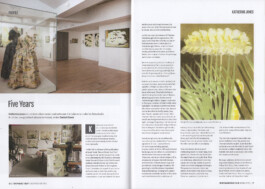
As the 300 year anniversary of Thomas Gainsborough’s death approaches, Fine Ladies And Gentle Men is Katherine Jones’s first Museum show. It takes place in Gainsborough’s House, Sudbury where he lived until he was fourteen years old. The exhibition opened on May 3rd and runs until October 19th, 2025. The works, mostly prints based on plant and flower forms, are a response to both the paintings and dresses on display.
Jones sees painting and printmaking as complimentary. She is a very painterly printmaker but the exhibition has also borrowed early ‘Soft Ruff’ paintings that were the beginning of her ‘linking flower forms to dress as embellishment’. (Katherine Jones, in conversation, June 2025)
Fashion and Nature are both cyclical and seasonal. Costume, accessories and other signifiers of high society are like the petals, stamen and colours of flowers Jones references. They help the bearer wield influence by, in the case of flowers, attracting pollinators, in the case of Gainsborough’s sitters, respect and entry to the upper echelons of their world. Jones highlights the similarities between them. Her works remind the viewer that flowers can be described in bodily terms; they have ‘heads’, pansies have ‘faces’, lilies ‘throats’. She uses these natural forms as motifs and foregrounds them in their own right, no longer lingering at the bottom of the official list of accepted subjects for art. Placed alongside Gainsborough’s works, they are worthy where once they might have been denigrated as too trivial.
Gainsborough was not a traditionally masculine painter stylistically if ‘masculine’ equates to formal – Jones refers to his techniques as being gestural, impressionistic and free. Although he loved landscape, he was reliant on commissions which meant focussing on portraits. There was and Jones acknowledges still is a hierarchy of respect for both themes and materials. Historical paintings and portraiture trump images of Nature. Oil painting is considered more important than printmaking. To hang both subject matters and media side by side in Fine Ladies And Gentle Men is still a rebellious act.
Sudbury was a centre for the silk weaving industry. Jones takes the leaves and branches of a, 400 year old Mulberry tree in the house’s gardens and foregrounds them and their floral counterparts beyond their use as pattern woven into the eighteenth century fabrics on display.
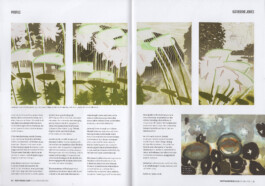
Where the leaves do recur as an overlapping motif, in Jones’s large, four panel print, Fine Ladies And Gentle Men, the repetitions are not quite that. They are variations, altered each time they appear and overlap, thanks in part to Jones’s use of the collagraph technique. The panels are textural, inked and printed in the same way as an etching and made in quite a painterly way. There is a spontaneity to the work. The texture holds various tones of ink and as with many of her works, they are hand finished.
The tree that inspired these works, was well established when the garden was Thomas Gainsborough’s. It provides the backdrop even now for both his and Jones’s works and a subject matter for hers. It is historic and lends a continuity that defies the transience of Nature.
During a residency at the newly opened Aspinwall Editions studio in the Hudson Valley NY Jones worked with master printmakers
Ann Aspinwall and Knut Willich on two silkscreen prints ‘Conks’ and ‘Sweet Kisses’. The starting point was the Turkey Tail fungi that thrive and grow as the wood they spawn from decays; death and renewal overlap each other, they are not linear. The work itself was made concurrently with the work for Gainsborough’s House. For Jones, her artistic practices often echo her themes and techniques.
Of the familiar forms, mainly flowers, in her exhibition Bright New at the Rabley Gallery that ran from September 21st to October 18th in 2024, Jones says:
Repeats in the work relate to the changing repeat of a hand printed image and also those in nature and time. The processes that take a sketch on its journey to a more
concluded painting or image are not linear though.
Katherine Jones, (in conversation, June 2025)
She always maintains the freedom to use the media best suited to the work. In this exhibition, panel paintings took centre stage but there was a cross-pollination between them and the prints. Another four panel collagraph, All The Springs We’ve Ever Had, references memories that echo with each emerging Spring. Virginia Woolf is important to Jones. She wrote:
Words, English words, are full of echoes, of memories, of associations-
Virginia Woolf (A Room Of One’s Own, 1929)
As with words, so with images and moments in time. A recurring theme for Jones is how we experience time. The first encounter with new growth is imprinted with the remembrance of other seasons. The experience, the act of looking, is both current and nostalgic. It is sensual and intellectual; honing in on the details of a flower engages both faculties. Jones does not value one above the other.
The concurrence of lived experience and literary influences aligns with Jones’s attitude to life and work. She does not value thought above sentiment or the creative work of an artist above that almost taboo subject if one is to be taken seriously; family life.
Jones and I met through our children. We each have two sons. Hers and mine have spent time in her studio where this article was born out of one of many conversations that always encompass other aspects of life. Jones believes that her work happens not in spite of mothering but that it is informed by it. It is as much an influence as her literary, folkloric and visual source material.
The domestic affects how she experiences literature and what works of art she is drawn to. Just as her work disrupts thematic hierarchies and what subjects are suitable for Art, so home life is traditionally considered a less cerebral, less artistic ‘breeding ground’ for that work. Jones speaks to the fact that personal and professional boundaries can blur without incurring a lack of focus or competence. In our conversations, she goes further, saying,
It’s fundamental to me to be honest about the relationship between home life and work; they are interdependent.
Katherine Jones, (in conversation, May 2025)
She brought nuanced, female archetypes into the heart of the male establishment, Eton College during We Grew The Long Bones, her exhibition there in 2020. She speaks of ‘quietly rebellious acts’, as she re-contextualises Nature and redresses the balance to make her historically feminine, marginalised subjects universal.